Crypto Trading Success Metrics: Beyond the PnL
Stop relying on PnL. Master the crypto trading success metrics like Profit Factor & Sharpe Ratio to find your edge and trade with data-driven confidence.
June 21, 2026 · 15 min read
Your PnL is often the most dangerous liar in your trading toolkit. It's easy to feel like a market wizard when Bitcoin is hovering around $64,295 and your balance is climbing; however, a green screen doesn't prove you've mastered the market. You've likely felt that underlying anxiety. You wonder if your recent wins are a result of genuine skill or just a temporary stroke of luck. Most traders struggle to identify which specific coins or timeframes are leaking capital. They end up buried under raw data without any actionable insights. This lack of clarity breeds emotional stress and leads to inconsistent execution.
It's time to look deeper. This guide will help you master the internal crypto trading success metrics that separate professional high-performers from the lucky 10%. You'll learn how to move beyond basic profit tracking to identify your true competitive edge. We are going to show you how to build a streamlined performance dashboard that transforms overwhelming data into a clear path for refinement. By the end of this article, you will have the tools to trade with data-driven confidence and the precision of a sophisticated institutional desk.
Key Takeaways
- Stop relying on PnL as your only guide. Learn why profit is a lagging indicator that often hides dangerous trading habits.
- Master essential crypto trading success metrics like Profit Factor and Win Rate to confirm your strategy's long-term sustainability.
- Pinpoint execution leaks. Analyze hold times and directional bias to see exactly where your capital is slipping away.
- Quantify your risk profile. Use Maximum Drawdown and the Sharpe Ratio to determine if your returns justify the market volatility.
- Transition to automation. Eliminate manual entry bias and build a real-time performance dashboard for total data-driven clarity.
Table of Contents
The Performance Trio: Win Rate, Profit Factor, and Risk-Reward
Advanced Portfolio Intelligence: Max Drawdown and Sharpe Ratio
Beyond the PnL: Why Your Profit Isn’t a Success Metric
Many traders mistake a growing account balance for mastery. In the high-stakes market of June 2026, where Bitcoin prices hover around $64,295.50, raw profit is a deceptive benchmark. PnL is a lagging indicator. It tells you where you’ve been, not where you’re going. Relying solely on your bankroll to judge performance is like driving a car while only looking at the rearview mirror. It provides zero foresight into future risks or strategy decay. If you don't look past the dollar signs, you're trading blind.
To truly evolve, you must distinguish between leading and lagging indicators. PnL is the final score. It's the result of your actions, but it doesn't explain the "why" behind them. Conversely, crypto trading success metrics like execution consistency and risk-adjusted returns are leading indicators. They predict your long-term survival. A deep understanding of cryptocurrency market dynamics reveals that "lucky" profits are often just the result of being on the right side of a random pump. These are not scalable. Scalable profits come from a repeatable process that works regardless of whether the market is trending or ranging.
The Trap of the "Green Day"
A profitable day can be your worst enemy if it reinforces bad habits. Did you ignore your stop loss and get bailed out by a sudden reversal? That is a "bad" win. Accidental victories breed overconfidence. They trick you into thinking you can outsmart the market without discipline. Professional traders focus on Expected Value (EV). EV is your true north. It represents the average amount you expect to win or lose per trade over the long run. If your EV is negative, your current "green days" are just a statistical anomaly before an inevitable crash.
Execution Quality vs. Outcome
High-performance trading desks don't just look at the ticker. They grade trades on process. You can make a perfect decision and still lose money; that is simply the nature of probability. Separating the quality of your decision from the market outcome is the hallmark of a professional. This mindset shifts your focus from the "what" to the "how." It removes the emotional sting of a loss and the hollow euphoria of a lucky gain. Execution Quality is the adherence to a pre-defined strategy regardless of immediate PnL.
Focusing on the right crypto trading success metrics transforms your approach from gambling to business management. You stop chasing the next big win and start refining the machine that generates those wins. It's about building a system that is robust enough to handle the 2026 volatility while maintaining a clear, data-driven edge.
The Performance Trio: Win Rate, Profit Factor, and Risk-Reward
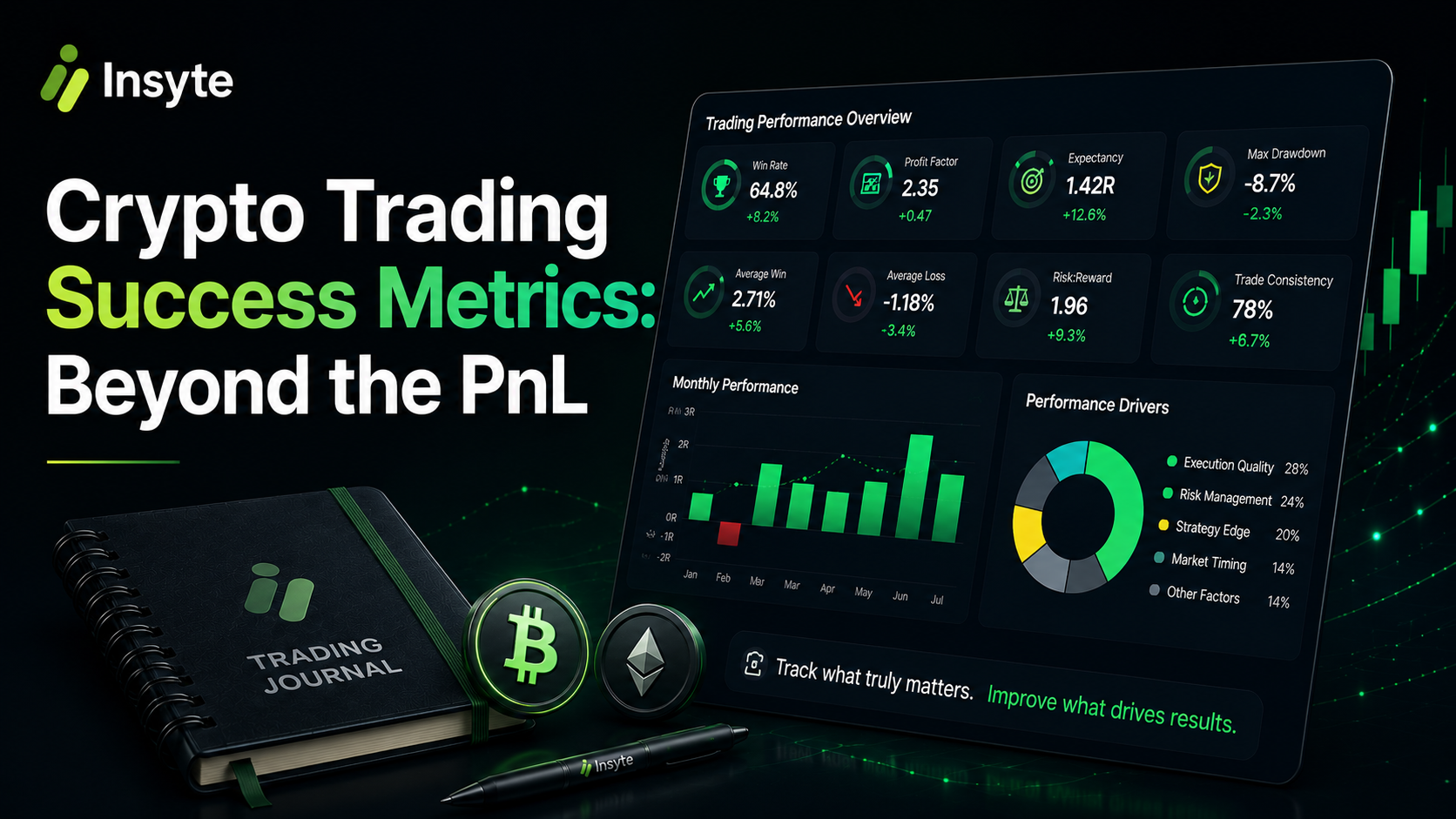
If PnL is the scoreboard, these three metrics are the engine. You don't need to be right all the time to build wealth. In fact, many professional desks thrive on win rates as low as 35%. The secret lies in the mathematical interplay between your win rate, profit factor, and risk-to-reward ratio (RRR). These are the definitive crypto trading success metrics that determine if your strategy is a scalable business or a ticking time bomb. When backtesting trading strategies, researchers often find that the most robust systems aren't the ones with the highest win rates, but those with the most consistent Profit Factors. Understanding how these numbers dance together is the first step toward true market mastery.
Calculating Your Profit Factor
The Profit Factor is perhaps the ultimate metric for strategy sustainability. It’s a simple formula: Gross Profits divided by Gross Losses. If you made $10,000 in winning trades and lost $5,000 in losing trades, your Profit Factor is 2.0. A value of 1.0 means you're merely breaking even. A Profit Factor of 1.5 is considered solid and professional; reaching 2.5 or higher puts you in an elite tier of execution. Be careful. A high win rate paired with a low profit factor usually indicates you’re "scalping pennies in front of a steamroller." One large loss can wipe out weeks of work.
The RRR Efficiency Benchmark
Your Risk-to-Reward Ratio (RRR) is your survival kit during losing streaks. It measures how much you're willing to risk to achieve a specific gain. However, there’s a massive difference between your "Planned RRR" and your "Realized RRR." You might plan for a 1:3 trade, but if you exit early due to fear or suffer from heavy slippage on high-leverage platforms like MEXC, your actual return might only be 1:1.5. These "slippage leaks" are where most traders lose their edge. Tracking the gap between your plan and your reality allows you to set realistic growth targets based on actual performance data rather than hope.
Mastering these ratios manually is a recipe for burnout. You can gain immediate clarity on these numbers by using Account Performance Reports to visualize your edge in real-time. This transition from raw data to actionable intelligence is what separates the lucky 10% from the professionals. Stop guessing and start measuring the crypto trading success metrics that actually move the needle.
Behavioral Metrics: Tracking Discipline and Execution Leaks
Discipline is not an abstract virtue. It is a trackable performance variable. While win rates and profit factors provide the "what," behavioral metrics reveal the "how." To truly master crypto trading success metrics, you must look at the decisions you make under pressure. Most execution leaks aren't caused by bad math. They are caused by human instinct overriding a proven system. Professional traders use data to identify these emotional fractures before they lead to a total account drawdown. If you can't measure your discipline, you can't improve it.
Hold Time Efficiency
One of the most telling indicators of a trader’s psychological state is the relationship between hold times for winners versus losers. Are you cutting your winners too early because of an "Anxiety Exit"? This happens when you close a position out of fear rather than a technical signal. Conversely, holding losers for days while hoping for a bounce is a classic discipline leak. By analyzing your profit per hour held, you can optimize your timeframe. If your highest returns come from 4-hour holds but you're constantly exiting in 15 minutes, you're leaving significant capital on the table. Efficiency is about maximizing return for every minute of market exposure.
Symbol and Ticker Analysis
Not all assets are created equal. You might have a massive edge when trading Solana at $71.57 but lose every penny when touching Bitcoin. Most traders find that 80% of their profit comes from just two or three specific coins. The rest are "Money Pits" that drain your mental energy and account balance. Using a Ticker Analyzer allows you to filter out these low-probability assets. By narrowing your focus to your "Alpha" symbols, you reduce noise and increase execution quality. You don't need to trade everything. You just need to trade what you understand.
Directional Bias and Consistency
Your Account Pattern Analysis might reveal a hidden bias. Do you perform significantly better in Longs than Shorts? Many traders struggle to switch gears when the market sentiment shifts. Identifying this bias allows you to either refine your shorting strategy or simply sit out during bearish phases. This level of self-awareness is reflected in your Trading Health Score. It measures how closely you follow your own rules. High consistency leads to predictable results. Inconsistent execution, even if profitable in the short term, is just gambling in disguise. Data-driven clarity removes the guesswork and replaces it with a streamlined path to mastery.
Advanced Portfolio Intelligence: Max Drawdown and Sharpe Ratio
Raw profits are a vanity metric. If you made 50% last month but endured a 40% account dip to get there, you're one bad trade away from ruin. Professional portfolio management requires a deeper dive into risk-adjusted performance. These crypto trading success metrics focus on the "vital signs" of your account. They tell you if your strategy is actually healthy or if you're just surviving on borrowed time. Mastering these advanced numbers allows you to scale your capital with confidence rather than fear.
Understanding Your Drawdown Profile
Maximum Drawdown (MDD) is the ultimate measure of your risk tolerance. It calculates the largest peak-to-trough decline in your account value before a new peak is achieved. If your MDD is too high, you'll likely hit a psychological breaking point and abandon a winning strategy at the worst possible time. Use your historical data to set "Circuit Breakers." These are hard stops where you pause trading to re-evaluate your process. Seeing the numbers clearly helps you manage the emotional weight of a losing streak. It's about staying in the game long enough for your edge to play out.
The Sharpe Ratio for Crypto
In the world of digital assets, volatility is a constant. A strategy that returns 20% with minimal fluctuations is often superior to one that returns 40% with wild swings. The Sharpe ratio measures excess return per unit of deviation. It helps you understand if you're actually being compensated for the risk you're taking. A high Sharpe ratio indicates a smooth, efficient growth curve that is easier to compound over time. When you analyze your crypto trading success metrics, aim for consistency over sporadic explosions of profit. High-performance trading is a marathon of efficiency, not a sprint of luck.
Recovery Factor and Health
How quickly does your strategy bounce back? The Recovery Factor measures your total profit against your Max Drawdown. A high score means you recover from losses rapidly, which is essential for maintaining momentum. This data feeds directly into your Trading Health Score, giving you a composite view of your overall stability. Don't let hidden risks hollow out your portfolio from the inside. You can get a detailed breakdown of these metrics today by generating your own Account Performance Reports to ensure your strategy is built to last.
Scaling with Clarity: How to Automate Your Success Tracking
Memory is a poor tool for performance analysis. Most traders suffer from "Manual Entry Bias," a psychological tendency to meticulously record big wins while conveniently forgetting the "accidental" losses. This filtered reality makes it impossible to master crypto trading success metrics. If your data is incomplete, your strategy is built on a lie. To scale effectively, you must remove the human element from the data collection process. Transitioning from a gambler's mindset to a quant's perspective requires an unfiltered, automated stream of truth.
Why Automation is Non-Negotiable
Precision requires automation. Manual journals are slow, tedious, and prone to error. An Automated Trading Journal eliminates these friction points by syncing directly with your exchanges in real-time. This ensures 100% accuracy in your records. It captures the hidden killers of profitability, such as taker fees, which averaged 0.046% for perpetual futures in June 2026. Automation also tracks slippage and execution lag that manual logs often miss. By capturing every data point, you provide the necessary fuel for AI-driven Account Pattern Analysis to identify behavioral leaks that the human eye simply cannot see.
Implementing Your Metrics Dashboard
Clarity comes from a unified view of your performance. You don't need to spend hours crunching numbers to understand your edge. A weekly "Performance Audit" should take less than 10 minutes when you have the right dashboard. Focus on high-impact visuals like Account Performance Reports to see your RRR and Profit Factor at a glance. These reports transform raw transaction history into a roadmap for refinement. It allows you to spot strategy decay before it leads to a significant drawdown.
Consistency is the only metric that guarantees long-term survival. Use the Insyte Trading Health Score to monitor your discipline across different market conditions. This composite score acts as a real-time pulse check on your execution quality. When you stop chasing "green days" and start optimizing your health score, you align yourself with the professional 10%. Data-driven trading reduces emotional stress and replaces it with the calm assurance of a proven system. Stop guessing and start growing with Insyte analytics.
Own Your Performance Edge
The transition from guessing to knowing is the defining moment in a trader's career. You've seen why PnL is a lagging indicator and how the performance trio of win rate, profit factor, and RRR provides the blueprint for sustainability. Mastery isn't about avoiding every loss. It's about understanding the behavioral leaks and drawdown profiles that impact your long-term survival. By tracking these essential crypto trading success metrics, you replace emotional volatility with data-driven clarity.
The path to the professional 10% is paved with automation. Precision requires it. Stop fighting manual entry bias and start leveraging high-performance intelligence. It's time to treat your trading like the sophisticated business it is. You have the strategy; now get the insights to make it unstoppable.
Master your metrics with Insyte’s Automated Trading Journal. Benefit from automated exchange syncing for 100% accuracy, monitor your real-time Trading Health Score, and uncover hidden edges with deep Account Pattern Analysis. Your evolution from a lucky trader to a market professional starts with the right data.
Frequently Asked Questions
What is the most important metric for a crypto trader?
The Profit Factor is the most vital metric for long-term survival. It measures the sustainability of your edge by comparing gross profits to gross losses. While PnL shows the final outcome, the Profit Factor reveals the efficiency of your process. A value above 1.5 indicates a professional, scalable strategy. Values below 1.0 suggest you're essentially paying the market to trade.
How do I calculate my trading profit factor?
Calculate your profit factor by dividing your total gross profits by your total gross losses. For example, if you earned $10,000 in winning trades but lost $4,000 in losing ones, your factor is 2.5. This number provides immediate clarity on whether your crypto trading success metrics are trending toward growth or decay. It's a fundamental calculation for any serious portfolio audit.
Why is my win rate high but I am still losing money?
You likely have a negative Risk-to-Reward Ratio (RRR). A high win rate is meaningless if your few losses are significantly larger than your many small wins. This often happens when traders "average down" on losers or exit winners too early out of fear. You're winning the battles but losing the war because your execution lacks mathematical symmetry.
What is a good Sharpe ratio for a crypto portfolio?
A Sharpe ratio above 1.0 is considered good in the volatile crypto markets. An elite ratio of 2.0 or higher indicates exceptional risk-adjusted returns. This metric helps you determine if your profits are a result of smart strategy or simply enduring extreme, unnecessary volatility. It's about finding the smoothest path to capital appreciation with the least amount of stress.
How often should I audit my trading performance metrics?
Conduct a tactical performance audit once a week to refine your execution and catch bad habits early. A deeper, more comprehensive strategy review should happen monthly to assess long-term crypto trading success metrics. Real-time monitoring is even better. Using an automated dashboard allows you to catch discipline leaks before they turn into significant account drawdowns.
Can an automated trading journal really improve my win rate?
Yes, an automated journal improves your win rate by identifying and eliminating low-probability setups. It removes manual entry bias, ensuring you see the raw truth of every trade. By reviewing your historical data, you can stop trading assets or timeframes where you consistently lose money. This refinement naturally pushes your win rate higher as you focus only on your edge.
What is maximum drawdown and why should I care?
Maximum drawdown (MDD) is the largest peak-to-trough decline in your account balance before a new peak is reached. You should care because MDD represents your true risk of ruin and the psychological pressure you must endure. A high drawdown often leads to emotional decision-making. Knowing your historical MDD helps you set "circuit breakers" to protect your capital during market corrections.
How do I identify which crypto tickers are my most profitable?
Use a Ticker Analyzer to aggregate your performance data by specific symbol. This tool reveals which assets are your "Alpha" generators and which are "Money Pits" draining your balance. Most traders find that the majority of their profit comes from just a few coins. Identifying these allows you to concentrate your capital where you have a proven statistical edge and ignore the noise.
← Back to all posts